

Editor’s Note: According to Silicon Valley insider Jeff Brown — the man who called NVIDIA before it rocketed 28,000% — we’re only at the foothills of the next big AI boom.
But this time, Jeff says the biggest winner won’t be a chipmaker…
It’ll be a company producing something he calls “AI Fuel.”
Remember when the American dream was still alive?
When a hard day’s work actually meant your family was taken care of…
And small towns were the backbone of our entire economy?
Most people think those days are gone forever.
But they’re dead wrong.
See, something incredible is happening in America’s Heartland that almost nobody is talking about.
A dying coal town in Wyoming — a place many wrote off decades ago — is turning into ground zero of a new American revival.

It isn’t because of coal… or gas… or even manufacturing…
It’s because of a breakthrough energy technology that Forbes says “may become the go-to energy source.”
One that could ignite a 33,000% boom, revive hundreds of forgotten towns…
And spark a new era of American prosperity — potentially unleashing $100 trillion into the economy.
This could turn countless everyday folks into millionaires…
IF they move fast.
Big Tech is already piling in.
Amazon, Google, and Microsoft all plan to rely on this technology.
NVIDIA is heavily invested.
Bill Gates has ploughed $1 BILLION of his own money into this technology…
Peter Thiel and Warren Buffett both have stakes…
As does Sam Altman, the CEO of OpenAI — the company that created ChatGPT.
And according to my boots-on-the-ground research…
One little-known company could become the biggest winner of this entire Heartland revival.
Partner Spotlight
For the last decade, Silicon Valley has operated on a dangerous fantasy. The fantasy was that we could digitize the entire world—streaming, cloud computing, crypto, and now AI—without worrying about the physical cost.
We were told that "data is the new oil." But we forgot that data needs electricity to survive.
In 2025, that fantasy is colliding with the hard laws of thermodynamics.
The Math of Intelligence
Here is the problem in simple terms: AI is incredibly hungry. A standard Google search uses about 0.3 watt-hours of electricity. A ChatGPT query uses roughly 2.9 watt-hours.
That is a 10x increase in power consumption for the same task.

Now, multiply that by billions of queries a day. Then add the "Training Phase" of new models (like GPT-5), which requires data centers running supercomputers at 100% capacity, 24/7.
If Google were to switch its entire search engine to AI today, it would consume as much electricity annually as the entire country of Ireland.
The International Energy Agency projects that by 2030, data centers will consume more electricity than Japan.
The "Green" Lie
The mainstream narrative says, "We will just build more solar panels and wind turbines." But Big Tech engineers know this is physically impossible for AI.
Data centers require "Baseload Power"—steady, reliable energy that runs 24/7/365.
Solar doesn't work at night or during cloudy weeks.
Wind doesn't work when the air is calm.
AI training runs cannot "pause" for the weather. If the power flickers for even a millisecond, the servers crash, potentially corrupting a model worth $100 million. Batteries are currently too expensive to store gigawatts of power for days.
This leaves only one carbon-free option that works 24/7.
The Nuclear Renaissance
This is why we are seeing a historic reversal. The same tech giants who avoided nuclear energy for decades are now rushing to buy it.
Microsoft just signed the largest nuclear deal in history to restart the Three Mile Island reactor. They are paying a massive premium (~$115 per MWh) just to secure reliable power.
Amazon bought a nuclear-powered data center campus in Pennsylvania for $650 million cash.
Google has partnered with Kairos Power to deploy a fleet of advanced reactors.
They realize that without nuclear energy, the AI revolution stops cold.
The Modular Revolution
When people hear "nuclear," they think of cooling towers and 1970s technology. But the real shift isn't about old-school plants. It’s about SMRs (Small Modular Reactors).
These are:
Safe: They use physics (gravity and convection), not electric pumps, to cool down. Meltdowns are virtually impossible.
Small: They can be built in factories and shipped on trucks.
Plug-and-Play: They can be installed directly onto the sites of retiring coal plants.
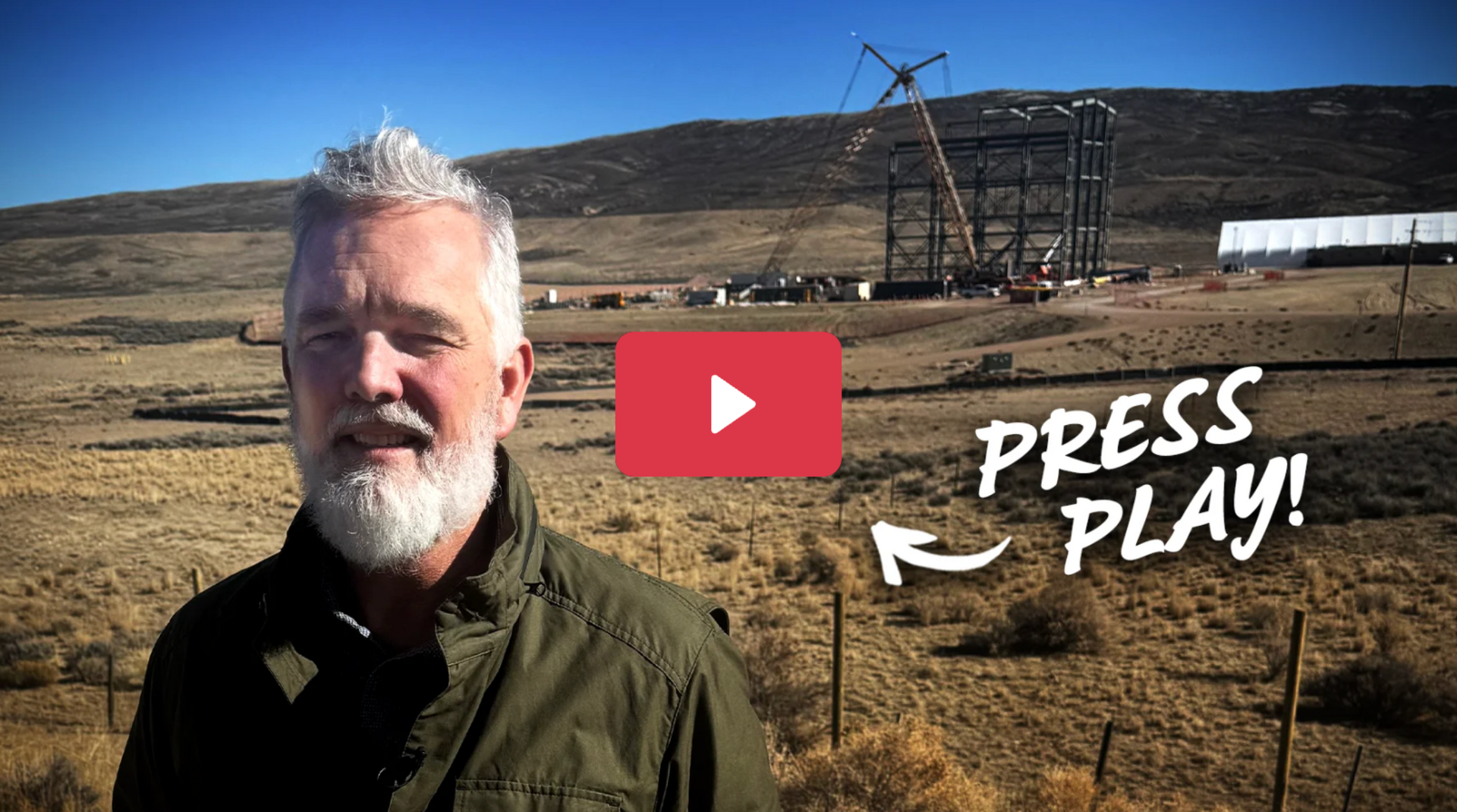
This logic explains the sudden activity in places like Kemmerer, Wyoming. To the unobservant eye, it’s just a fading coal town. To an engineer, it’s a goldmine of infrastructure. Why? Because retiring coal plants already possess the transmission lines and the grid connections. Building new high-voltage transmission lines in the US takes 10+ years due to regulations. Using old coal sites cuts that timeline in half.
This is why Bill Gates’ company, TerraPower, broke ground on a $4 billion "Natrium" reactor right there. It is the blueprint for re-industrializing America: converting "dirty" coal infrastructure into clean "AI Fuel" hubs.
The Compass Ahead
The market is currently obsessed with the "Brain" of AI (Nvidia chips, ChatGPT software). But history shows the longest-lasting fortunes are made in the "Body"—the infrastructure that keeps the brain alive.
We are witnessing a massive transfer of wealth from digital code back to physical atoms. The bottleneck for the next decade isn't computing power; it's electrical power.
The investors who realize that "Volts are the new Gold" will position themselves ahead of a $100 Trillion super-cycle. Don't look at the flashing lights of the Nasdaq. Look at the power lines in Wyoming.
Stay independent.

